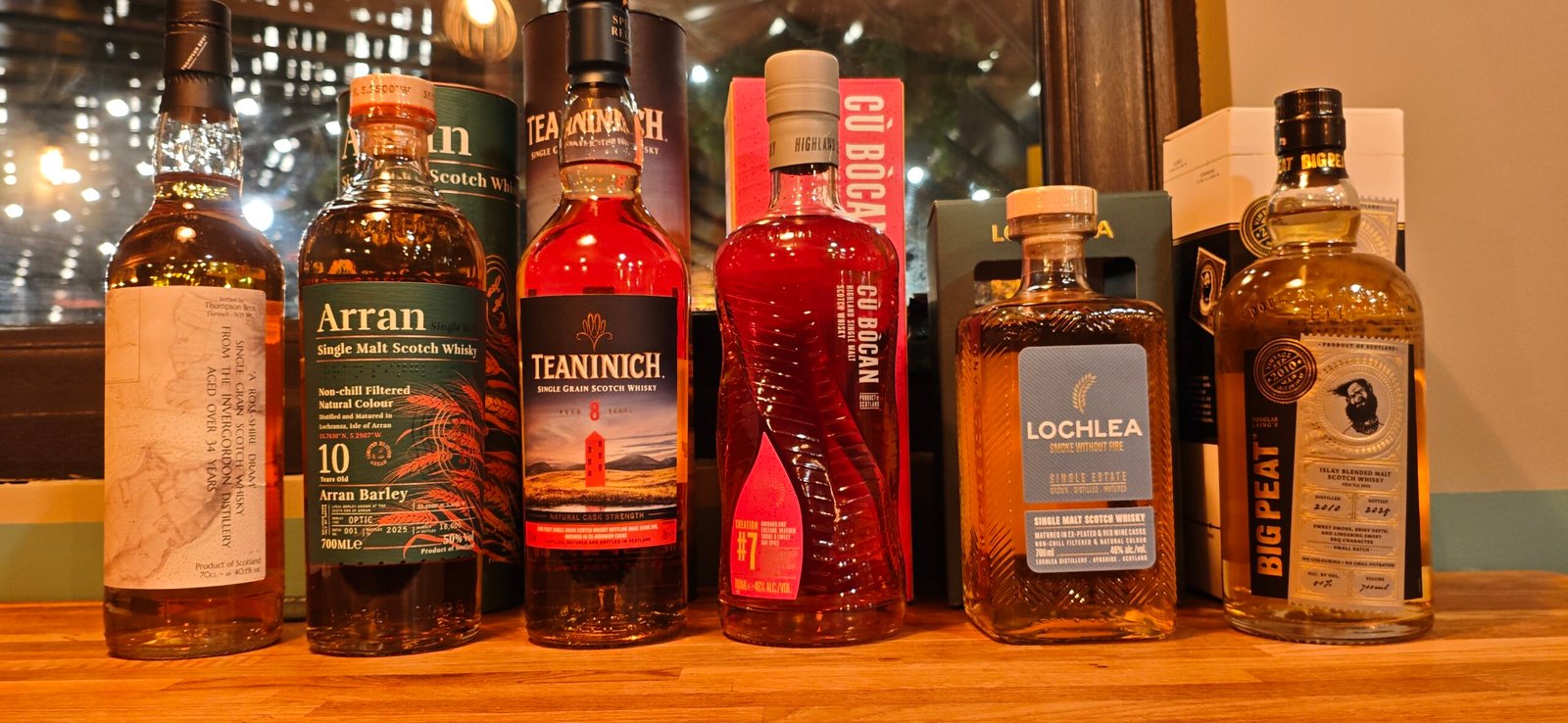
An exploration of our favourite spirit from Scotland
When: 24th January 2026
Where: The Yard – Ely
Host: Elliott Drinks Whisky
I always enjoy having two tastings close enough together around the same theme. While I do try to keep some similarities between the line-ups, I do ensure that all of the bottles are different. Partly, it makes my life easier if I don’t have to research notes for up to 12 bottles, but I recognise that if you do happen to come to both tastings, you want something different; I’m one of the people attending both, and I can confirm I do want to try a different line-up! In terms of the common threads I might choose to weave through two line-ups, using the same distillery is always good, giving you a chance to see any contrast between two of their expressions, or to pick a certain style but from a different producer. Here, compared to at Thirsty for our official club event two nights prior, I kept two distilleries, and I’d say 3 styles in common, but as the theme is Scottish whisky, it’s fairly natural to have lots of contextual information overlap when presenting these events, even if they look like 6 quite different bottles each time.
The Whisky
(Click on the images to buy a bottle)
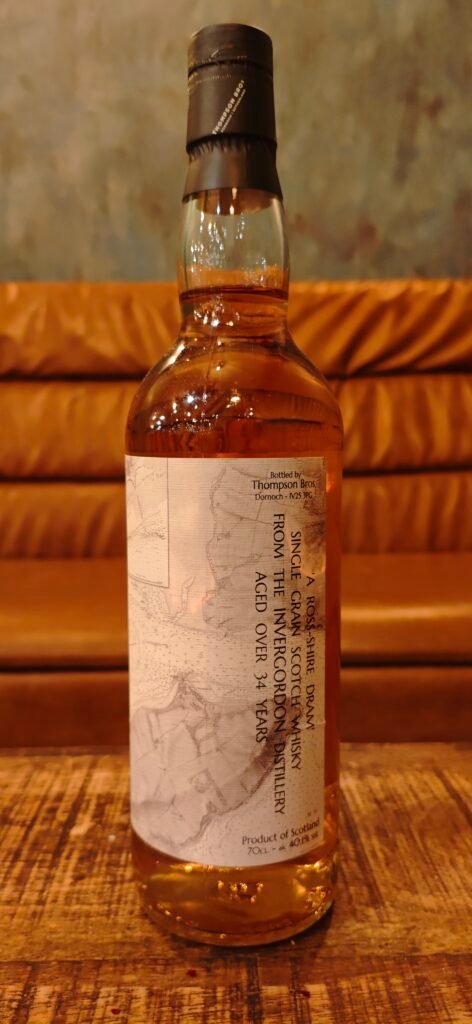
Thompson Bros. – Invergordon 34yo
Single Grain Scotch Whisky – 40.1%
The Thompson brothers have a knack for releasing phenomenal bottles of whisky. They have a great passion for their craft when it comes to all aspects of sourcing, finishing, marrying, blending and producing from their home in Dornoch. While their tiny distillery is slowly racking up barrels and drip-feeding us bottles, they spend the rest of their time providing interesting, independently bottled expressions like this.
Part of a (fairly informal) range of 3 single grain Scotch whisky releases, this well-aged Invergordon doesn’t come with a whole lot of information. We know the important things, like it being natural colour and non-chill filtered, but I couldn’t find details on the barrel-ageing history. Not that this is too concerning, Thompson Bros. has earned our trust now, and this bottle truly delivered an exceptional experience.
Notes: 👃🏻Caramel, creamy, vanilla, char, tropical chocolate & fruit 👄White toast, oak but soft, cereal, little rum, white icing, some berries.

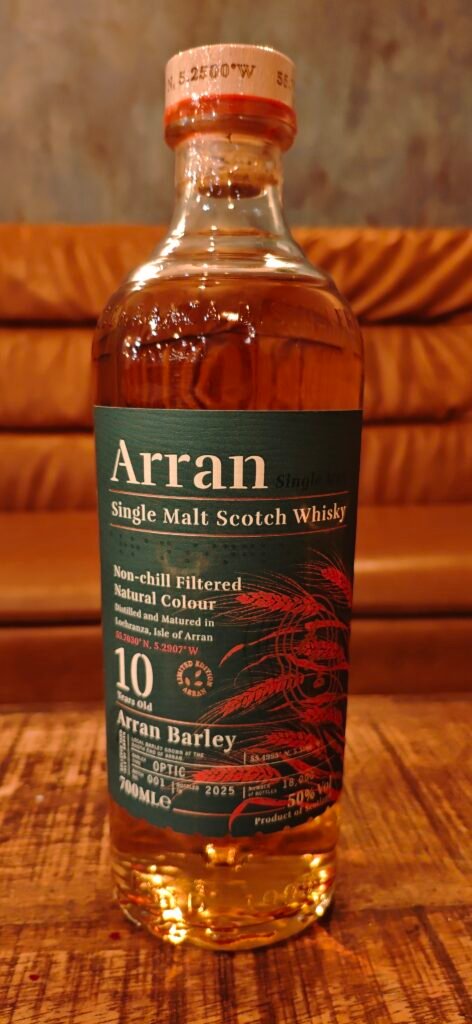
Arran – Arran Barley 10yo
Single Malt Scotch Whisky – 50%
Throughout the first half of both of my Burns Night line-ups this year, I gave different grains a good platform. Each line-up featured (effectively) 2 single grain whiskies out of the first 3 bottles (sure, one may not be officially labelable as Scotch whisky), but this bottle is a single malt with a grain story to tell.
Arran single malt whisky (from the Lochranza distillery on the Isle of Arran) is mostly made using the Concerto variety of barley. This bottle, however, is the first in a series of releases that will use different varieties and explore different cask maturations. For this first entry, they’ve used Optic barley from a local Arran farm and aged the spirit in a mix of bourbon and sherry barrels similar to their standard 10 year old.
Much like different grapes with wine, there is a vast whisky canvas to paint with barley varieties. Concerto has, within the last 10 years, been overtaken by Laureate, in Scotland, as the most used for making whisky. When we look at England, there’s a bit more diversity, and I think that’s partly because the operations are often smaller and a little more artisanal in their approaches. Regardless, the industrially popular strains tend to be so because of crop & alcohol yields (same goes for yeasts as well), and older barley varieties, which may have been less hardy or fermentable, often had different flavours, which was what made them attractive in the first place. I’m all for this kind of exploration!
Notes: 👃🏻Citrus, oak, caramel, buttered rye bread, clay 👄Kiwi & lime, pepper, aniseed, oat chocolate.
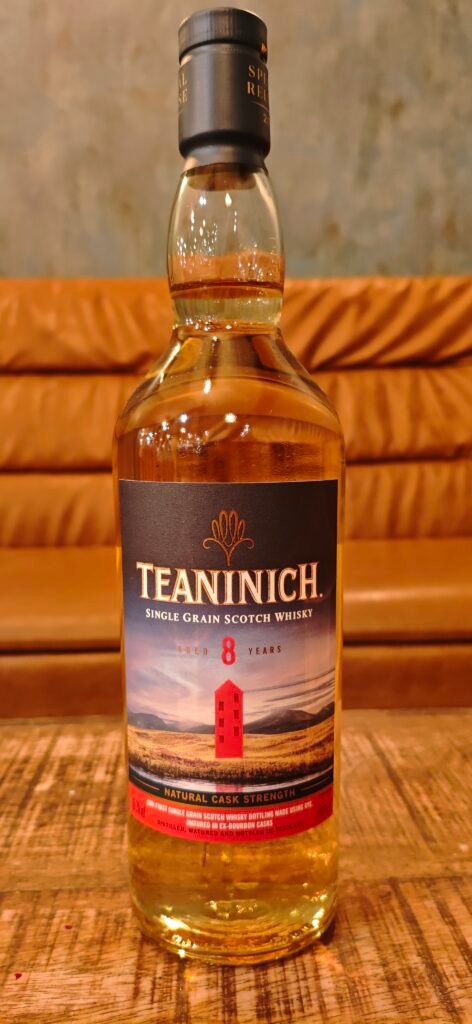
Teaninich – Daring Rye 8yo
Single Grain Scotch Whisky- 60.3%
The second grain whisky of the night was decidedly less controversial on paper than its slot 3 counterpart from my Thirsty tasting a few days prior, but it is still pretty unusual! This (a first-of-its-kind release from Teaninch) is a Scottish rye whisky (mashbill of malted rye and malted barley), distilled in a pot still (rather than a column still), from one of only 2 distilleries in Scotland that use a mash filter.
Most distilleries use a mash or Lauter tun to soak their grains and release the starches, and to then filter out the solids and send on the wort for fermentation. A mash filter is a piece of equipment that pulls the filtration step out into a separate stage; they provide better filtration of smaller solids than you can achieve from a combined tun, but are more expensive to run. For barley, you don’t need the extra filtering, but for rye, a mash filter really comes into its own.
As a Diageo special release, we don’t know a lot about future plans with this style of output from Teaninich. Some years ago, there was a Johnnie Walker High Rye release which would have contained something like this, but whether we’ll get to see more of it out in the open is yet to be seen. Despite the high ABV, there wasn’t a strong sense of it on the nose, and while it did present in the mouth, it certainly wasn’t in charge. For me, it had a characteristic ‘mixed grain’ chocolatey taste – I hope we do get to see some more.
Notes: 👃🏻Cereal, bread, underripe banana, jelly beans, vanilla 👄Fancy toast, alcohol fire, cocoa, new make, dark chocolate, ginger, creamy stout.
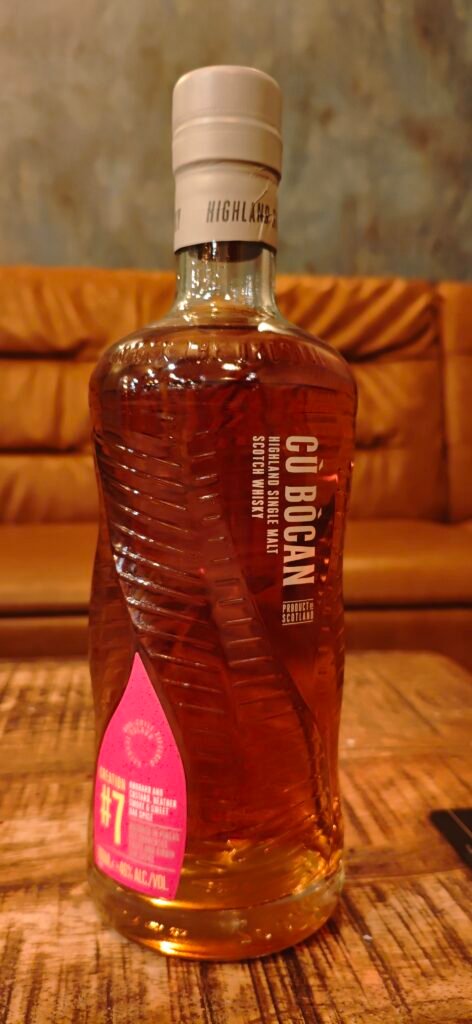
Cù Bòcan – Creation #7
Single Malt Scotch Whisky – 46%
It had been a few years since I’d introduced a Cù Bòcan, but I have fond memories of their brand of highland smoke: it’s subtle, but undeniable. And, the Creation series has always embodied that, whilst playfully experimenting with casks to produce delicious and different whiskies. This, the 7th edition in that series, is no exception, marrying virgin oak and Pineau des Charentes Rouge casks – the latter being an oak aged French fortified wine produced by combining ~1 year old cognac with unfermented grape juice (to prevent its fermentation).
This brand, which Tomatin distillery uses to release its smokey whisky (made only during 1 week every winter since 2005), is named after the black ghost dog with fiery red eyes that is said to haunt the village, and vanishes in a puff of smoke. This release, however, with the red (fortified) wine effects, and especially with the distillery subtitle of Rhubarb & Custard, feels less demonic, and more like a different, eponymous (misspelt) cartoon dog: playful and adventurous.
Notes: 👃🏻Vanilla, soft clean smoke, treacle, purple Jelly Babies 👄Heather & honey, vegetal smoke, red wine sweetness, floral.
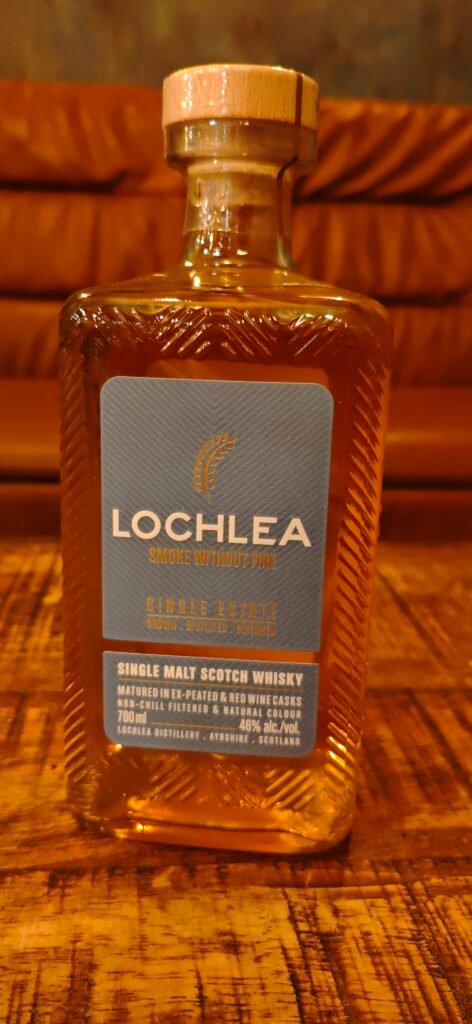
Lochlea – Smoke Without Fire
Single Malt Scotch Whisky – 46%
Here we have one of the distilleries I kept a constant across both of my Burns Night tastings this year. On the journey through this back half, allowing peat influence to grow, and providing an introduction to an interesting alternative way to add that influence, this Lochlea sits comfortably. One of their newly released core bottlings, this expression is an evolution from the seasonal Ploughing series.
As with the previous bottle, there are some red wine casks in play (although not fortified here), but it’s the addition of the ex-bourbon barrels that previously held peated whisky that sets this bottle apart. It’s not a new technique, as a way to give a whisky a smokey spin, but it is still somewhat rare, and I haven’t done the research, but I don’t think there are very many distilleries with a core bottling that does it.
Notes: 👃🏻Vegetal smoke, chlorine, apricot, chalk, distant ash 👄 Creamy, green apple, earthy, ginger, herbal tea.
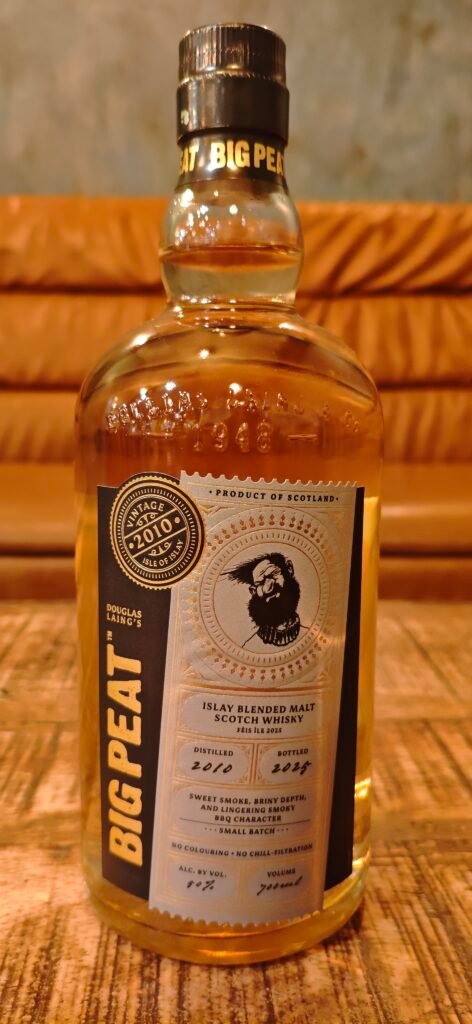
Big Peat – Fèis Ìle ‘25
Islay Blended Malt Scotch Whisky – 50%
You can’t go wrong with Big Peat. To top off a tasting with a solid example of what a heavily peated whisky can taste like, you don’t have to look much further. The original member of Douglas Laing’s blended Remarkable Regional Malts series, Big Peat comes in many finishes and forms, but it pretty much always packs a peaty punch. This expression is a rare thing, though, as it features a vintage and bottling date, allowing us to infer a rough age. All of the blend components were laid down in their casks in 2010, so with a bottling date of 2025 (released to commemorate Fèis Ìle that year), we know we have 14 or 15 year old Islay whiskies.
The bit of the circle I can’t quite square is that Big Peat advertise their components as Caol Ila, Bowmore, Ardbeg and Port Ellen – but Port Ellen ceased operations in 1983. Maybe the refill casks that this blend is reported to have matured in featured some Port Ellen barrels? No matter that gap in my knowledge, this bottle was a refreshing change to me compared to the last handful of Big Peats I’ve tried, as they were all fun cask finishes. But this was a pretty direct, intense, smokey thing – a wonderful finale.
Notes: 👃🏻Aniseed, citrus jelly, bonfire 👄 Tyres, iodine, ash, agave, cinder toffee.
The Winners
Vote Winner: 😅
Close Contender: Everyone
Now, I forgot to take a vote. I’ve no real excuse, but I was enjoying hosting this event, and with a bit of a mix-up with the venue, we ran short on time. I spent a lot of time talking to people throughout the tasting, and I know each bottle had its fans. Without looking back through my recent reviews, this felt like one of my better back 3s lately, with steadily growing and noticeably different levels and flavours of peat. And, I think the grain tour through the front 3 showed contrasting styles well. No bad bottles (or bottle placements, more accurately, as I don’t really think there are bad bottles), and a great crowd who enjoyed themselves, as I did too.