A dive into Irish whiskey, on the most appropriate day for it
When: 17th March 2026
Where: The Yard – Ely
Host: Elliott Drinks Whisky
I am writing this review somewhat later after the event itself than usual, mostly due to a holiday to Türkiye, so my memories of the night aren’t as vivid. But, I do remember that we had a great time together – the audience that attends the events in Ely is always lovely. It might mean, however, that my bottle write-ups are a little less lived-in.
I’ve never presented a 100% Irish whiskey line-up before. There’s no particular reason for that; maybe a mix of timing and a vicious circle of feeling inexperienced in talking about them. A St Patrick’s Day tasting provided the perfect opportunity to dive in though. In doing my research, I feel like I did learn a good deal about the divergence of the Scottish and Irish whisky industries and how the decline in the late 20th century left the state of it. Perhaps that’s a partial third reason for not having jumped to do a tasting like this before – a misconception about the complexity and variety of whiskies available.
I was aware of the fact that the number of working distilleries had contracted to just 2, and that they were owned by the same company, remaining to pump out the handfuls of successful remaining brands. From the bottles I had presented over the years, I also knew that there were new distillers, bottlers and blenders staging a comeback, but I think there’s still a bit of a stigma about what the drink is like, and that impacts what is available for me to put into a line-up. Taking a bit of time to look more deeply into what was out there though, painted a picture of a flame burning with a growing number of producers focusing on the (lost) history and how that can be presented to drinkers now. So, in the end, my line-up tried to reflect that up-and-coming vibe, with a focus on what was, what is, and what will be.
The Whisky
(Click on the images to buy a bottle)
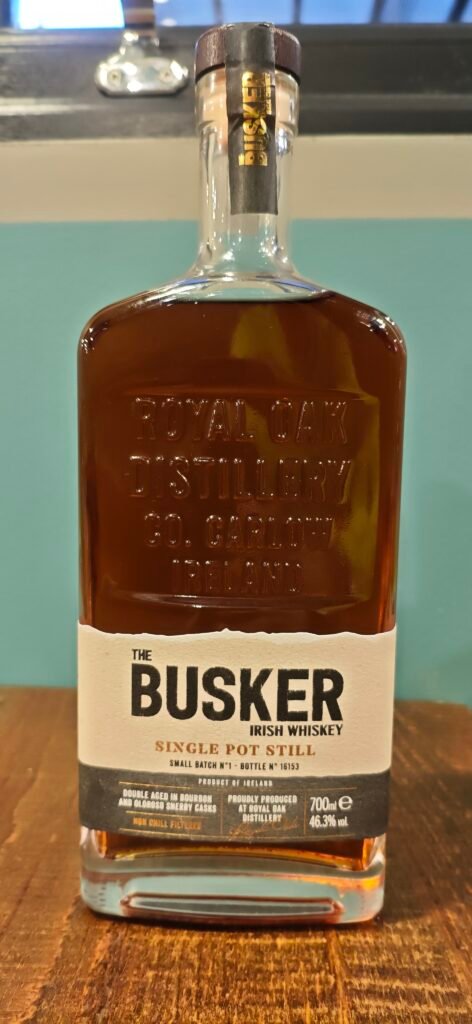
Busker – Small Batch Pot Still
Single Pot Still Irish Whiskey – 46.3%
The archetypal style of Irish whiskey is single pot still. It’s the main differentiator with Scottish whisky, and in my research, I gathered that an unwillingness to deviate from the style was a contributing factor in the 20th century downfall of Irish whiskey. While Scotland embraced blending and column stills, enabling them to tailor flavours to drinkers looking for smoother, easier drinking whiskies, Ireland stuck to their guns with pot stills and mixed mash bills, producing a chewy, heavier spirit (in sweeping generalisation).
Of course, I had to feature a single pot still Irish whiskey in this line-up. This bottle (while not the one I had planned to present, due to a warehouse mix-up) still perfectly represents that historical style. It’s also an example of investment in revitalising industry, as the Busker brand comes from a new, large distillery, operated by the owners of Disaronno, also capable of producing single malt and single grain Irish whiskies.
With bourbon and sherry cask maturation, and a high malt mash bill, but including wheat, chewy and heavy does seem like a fair assessment. They do say this is non-chill filtered, but state that it is ‘natural tint’ – I don’t know if that means no colour, or only a little. Nevertheless, it was a good example of the single pot still style.
Notes: 👃🏻Big orange oil, some ginger beer, fudgey berries 👄Pepper, citrus & leather, creamy grain.

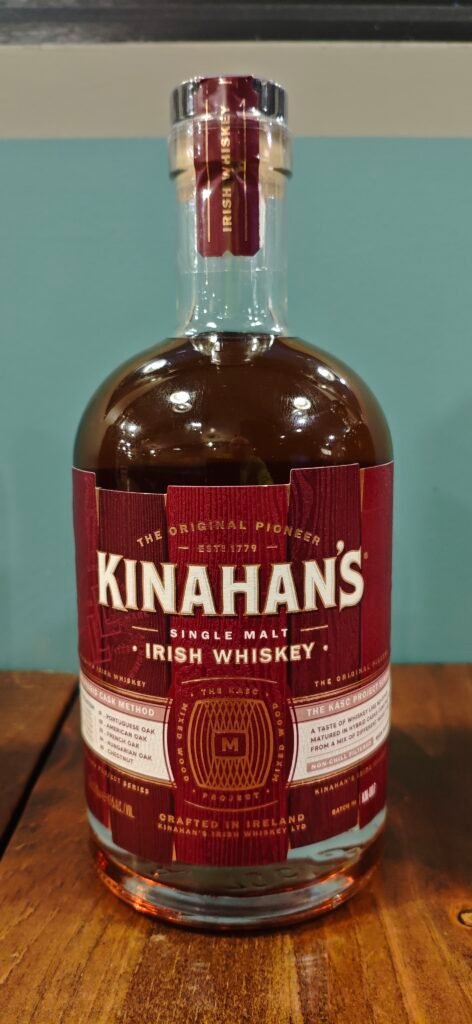
Kinahan’s – Kasc Project M
Single Malt Irish Whiskey – 45%
Originally founded in Dublin, in 1779, the Kinahan’s brand was respected around the world. It received a royal warrant from Queen Victoria, and praise from the ‘Father of American mixology’, Jerry Thomas, in his late 19th century cocktail book. They were also the first to defend a whisky trademark in a legal battle. So, a lot of history before it disappeared into obscurity by the mid 20th century, being swallowed by several mergers. But, in 2014, the brand was acquired and relaunched from a Dublin HQ on the same street as the original.
The new start focused initially on independent releases of Irish whiskies, but soon they wanted to return to making history themselves. They started their Kasc project releases: finishing whiskies (blended and single malts) in their groundbreaking hybrid casks. Using staves from multiple different barrel types, they can reproduce the act of cask marrying in a single barrel. They combine Portuguese, American, French and Hungarian oaks along with chestnut. Arguing that each element provides different characteristics to the final product, the spirits previously held in the component-casks, as well as the inherent differences of the woods themselves represent a genuinely different way of doing things.
This is their single malt expression, and while we couldn’t tease apart the 5 different contributions, there was definitely something different going on!
Notes: 👃🏻Serious cereal funk, damp, fragrant, apple & pear, bready 👄Cocoa, char, salty, pear, milk bottle sweets, hard nuts.
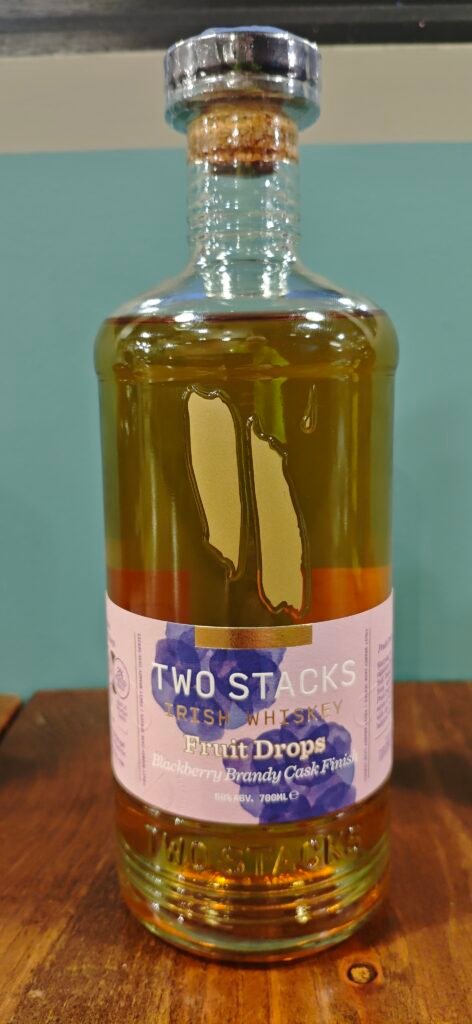
Two Stacks – Fruit Drops Blackberry
Blended Irish Whiskey- 50%
I really like what Two Stacks do: they are a bonder and bottler of Irish whiskey (mostly, it seems, from the Great Northern Distillery) seeking to make their drinks accessible and appealing to many. To them, that means affordable prices and attractive flavours which can unite drinkers and non-drinkers.
But, to be up front, this expression was a little disappointing to us in the room. This Fruit Drops series is something I’ve seen around since late last year and wanted to try. A 5-part blend of pot still, single malt and grain whiskies with oloroso, bourbon and virgin oak aging, plus a 2% peated single malt component, all married for a finish in Californian ex-bourbon barrel fruit brandy casks. We had the blackberry edition, with apricot and apple editions out there too. I was hoping for a juicy fruit bomb, but the fruit side was subtle, and despite being only 2% of the liquid, that peated spirit had a loud voice in the blend – while that isn’t something inherently bad in a whisky, it certainly wasn’t what we were expecting.
Notes: 👃🏻Earthy, vanilla cereal funk, toffee, balloon 👄Vanilla, blackberry, cocoa, grassy, grapes, Iced Gem biscuits.
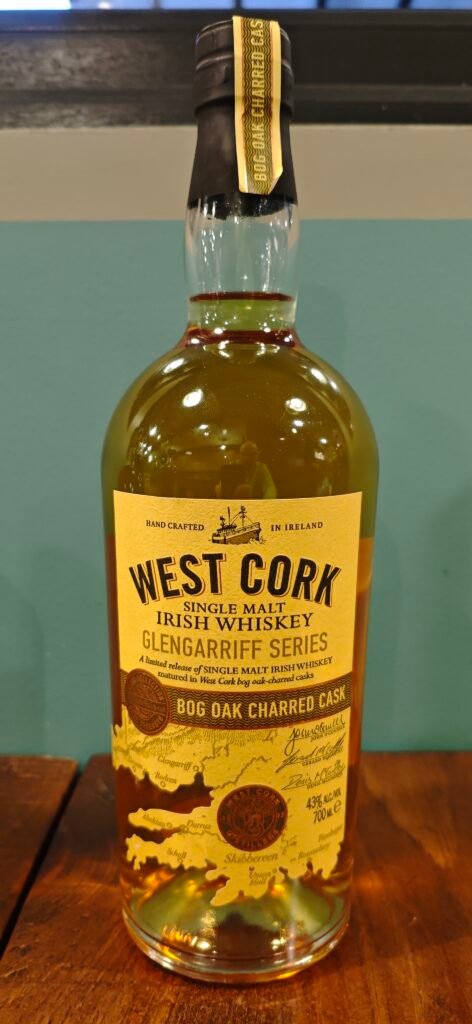
West Cork Distillers – Glengarriff Bog Oak Charred
Single Malt Irish Whiskey – 43%
While this bottle made it into the back half of the line-up, it isn’t made using peated barley. The special thing about this expression is how the casks were prepared for finishing the whiskey. West Cork Distillers were founded in 2003 in the back of a house of one of 3 founders. Rather than take a more traditional route of gin or vodka production, they started by selling ‘brown spirit: a blend of new grain spirit with young whiskey (likely bought in), further steeped with cereals and filtered through oak to add more colour and complexity.
Despite this niche starting point, they’ve gone on to be one of the most successful contract fulfilment distillers in Ireland at the moment. They produce spirits (not just whiskey) for places like Aldi & Lidl, and for celebrity brands. Similarly to Kinahan’s Kasc project, with this Glengarriff series, West Cork Distillers wanted to show they could still stay in touch with their experimental roots.
Focusing on their natural surrounds, and through scaling up of some of the process they’d used in those early days, they began to investigate cask charring. The Glengarriff series features two novel cask charring methods. Normal cask charring tends to use a gas-powered flame source, instead West Cork Distillers used either burning peat or burning oak reclaimed from bogs. This is the bog oak charred expression – it is initially matured in sherry barrels before being treated to a 6 month finish in those bog oak charred casks.
Typically, the cask charring imparts negligible amounts of smokey character to a whisky, so that wasn’t my expectation when selecting this bottle, but a lot of character does come from the cask, so a novel charring method should offer something. And I think there was definitely something unusual about this whiskey.
Notes: 👃🏻Sweet menthol smoke, cashew, fizzy key sweets, ginger 👄Biscuit, crunchy nut, damp earth, milky.
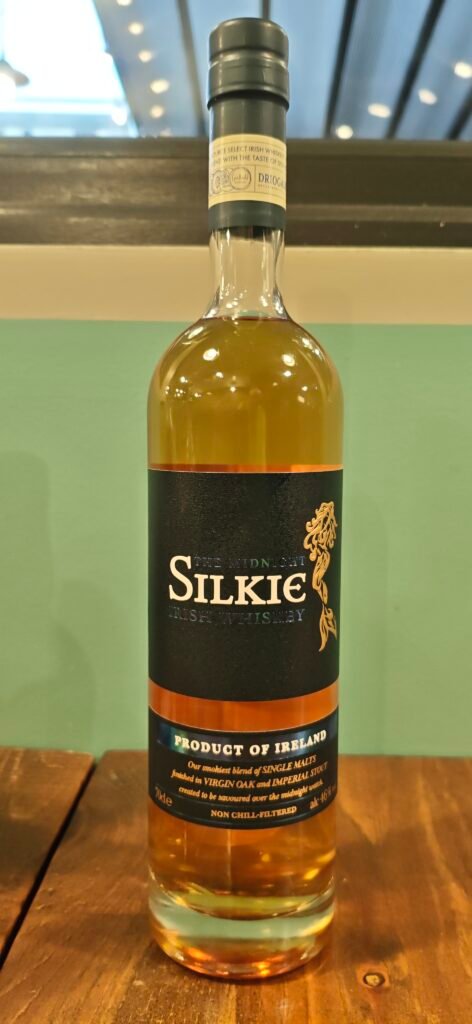
Sliabh Liag Distillers – The Midnight Silkie
Blended Malt Irish Whisky – 46%
Sliabh Liag Distillers have been operating since 2014, though their full distillery has only been operational since 2021, with earlier productions taking place in a more temporary location, and originally from a kitchen set-up. They are another case of a desire to recapture the lost (lapsed?) history of Irish whiskey making. This time there was a more direct family connection, but the dream was to create ‘Donegal-style’ heavily peated, triple distilled Irish whiskey. Whilst peated whiskies have been rare from Ireland in the last couple of decades, they’re coming back.
This bottle is part of a blended series that Sliabh Liag Distillers were releasing (and are continuing to) while their own stock was aging or waiting for a distillery to make it. More aligned with their own target profile, this version is the smokiest in the range, and it’s the only one that is 100% malt. With a cask make-up of sherry and virgin oak finishes, imperial stout, red wine, oloroso and bourbon casks, there is 35% of the spirit mix that is fairly heavily peated. Finally, it is all married together in imperial stout and virgin oak casks.
Notes: 👃🏻Ashy cocoa smoke, some hot dog, apricot 👄Pepper, bacon crisps, burnt brown sugar, mincemeat (fruit filling), charcoal.
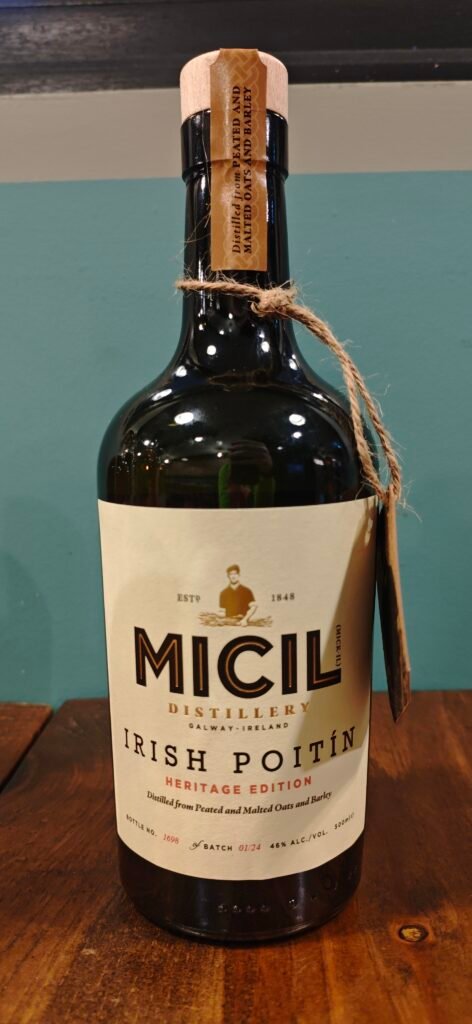
Micil – Heritage Edition Poitín
Irish Poitín – 46%
I wanted to feature a bottle that represented the true origin of Irish whiskey. Back in the mists of time, when Ireland and Scotland were whisky-ing more equally, there was no cask aging meaning new make or more gin-like spirits were what people were drinking. In Ireland, poitín and whiskey were 2 names given to these spirits, and the only difference was that whiskey was licensed. So, poitín was effectively Irish moonshine, although it was legalised in 1997. Sometimes it contained botanicals, but it is essentially pot still whiskey new make.
Micil is named after the founders’ poitín-making great-great-great-grandfather, making them a 6th generation distilling family, still based in the same area. They run an exceptionally small operation, filling about 4 (small) casks a week ot lay down for aging into whiskey. A lot of what they’ve sold so far is independently bottled whisky. However, their main passion is poitín, and they make it using 100% Irish barley, oats, wheat and rye, sourcing those as locally as possible.
This is their heritage edition which features 80% barley & 20% oats, all malted and smoked with peat from their familial land. There is also a touch of the botanical bogbean, a fen/bog plant collected from the local area, added to introduce a herbaceous spice.
When I poured this, the obviously clear spirit had people a bit suspicious, and while it’s fair to say not everyone was on board, it did open the eyes of some people too. For me, it was unlike the new makes I’d tried before, and definitely something I’d look out for trying some more varieties of.
Notes: 👃🏻Little chlorine, Kendal mint cake, TCP, mezcal 👄Balloon, rubbery, cocoa, aniseed, cinnamon fireball, herbal.
The Winners
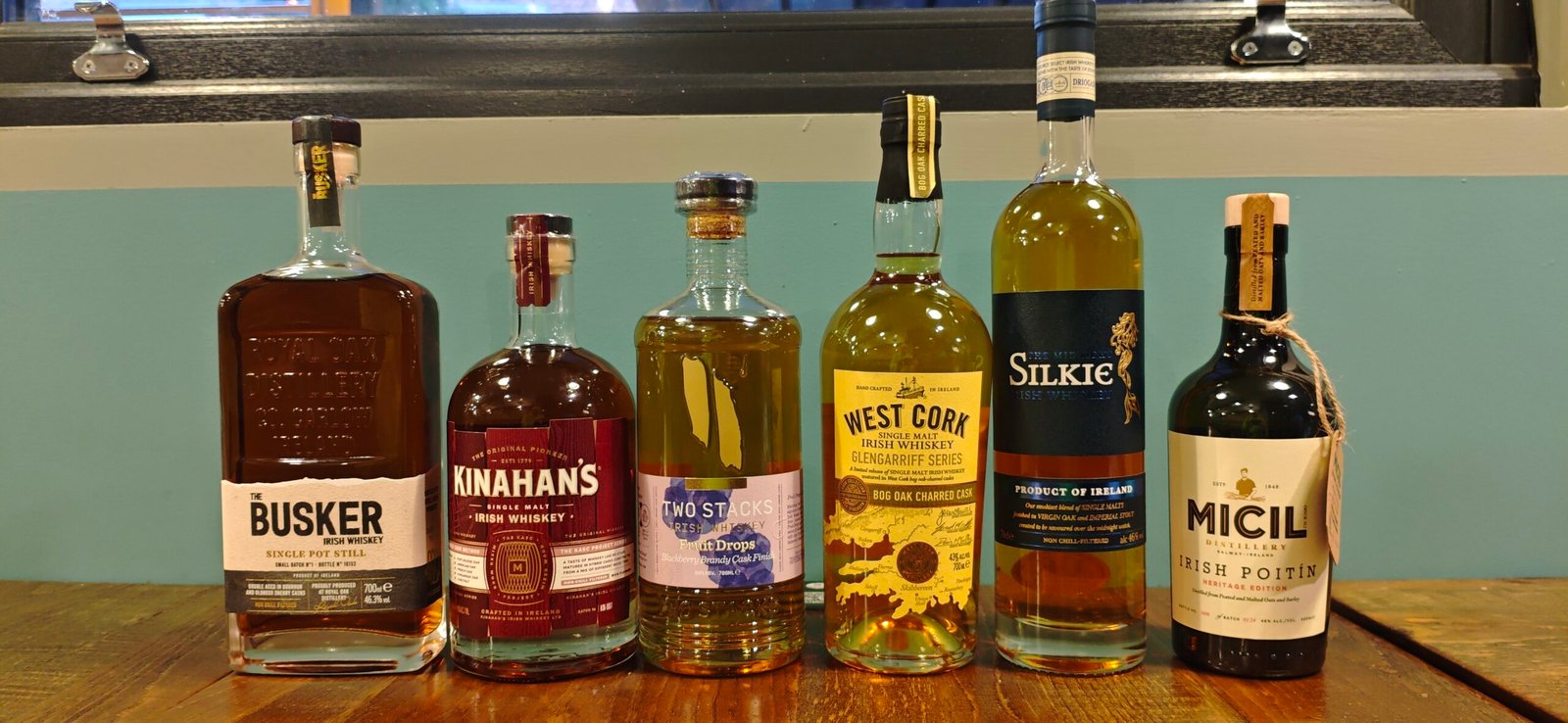
Vote Winners: Bottle #1 – Busker & Bottle #5 – Midnight Silkie
Close Contender: Bottle #2 – Kinahan’s & Bottle #4 – Bog Oak Charred
I was happy that the Busker single pot still whiskey earned a place on the winners’ podium, as that kind of reinforces the idea that Irish whiskey, even without any frills, has something special going for it. I’m also not surprised that the Midnight Silkie made it up there too; a well balanced smokey blend is often exceedingly appealing.
To have them closely followed by 2 experimental cask whiskies is nice to see too. People will embrace twists on the more standard formula that less ambitious producers seem bound by. And people are willing to try new things. I hope that, at least from our small sample of consumers sat enjoying ourselves in Ely, this might reinforce the notion that Irish whisky is back on the rise.